How to Choose the Right Falling Film Evaporator for Your Industrial Needs

Choosing the right evaporator is an important decision for industries that require efficient liquid concentration, energy savings, and consistent product quality. Different industrial processes have different evaporation requirements depending on the type of liquid, production capacity, temperature sensitivity, and desired concentration levels. Among the available evaporation technologies, falling film evaporators are widely used because of their efficient heat transfer, short product residence time, and suitability for heat-sensitive materials.
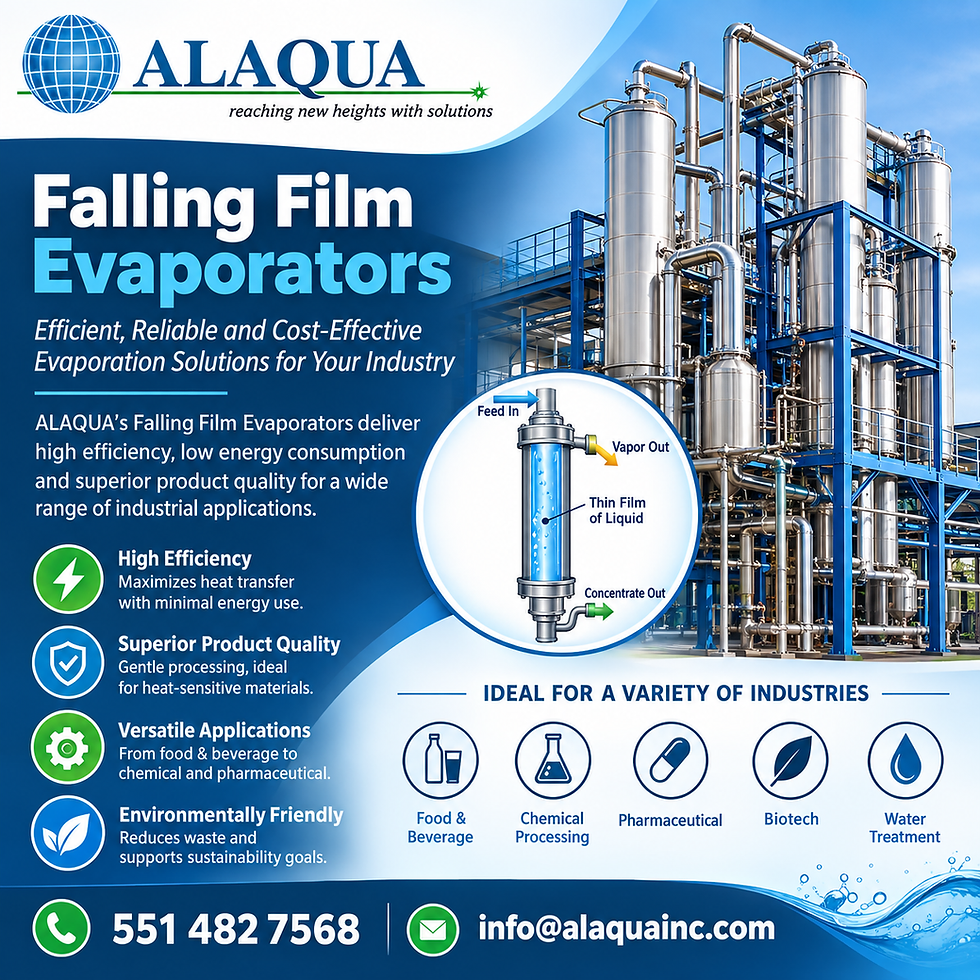
Industries such as food processing, pharmaceuticals, chemicals, and dairy manufacturing rely on advanced evaporation systems to improve production efficiency and maintain product quality. However, selecting the right equipment requires careful consideration of several technical and operational factors.
In this article, we will explore the important factors to consider when choosing the right falling film evaporator for your industrial needs.
1. Understand Your Industrial Processing Requirements
The first step in selecting a suitable falling film evaporator is understanding your production requirements. Every industrial application has specific evaporation needs based on the characteristics of the liquid being processed.
Consider the following factors:
Liquid composition: Identify the physical and chemical properties of the liquid.
Feed concentration: Determine the initial concentration of the material entering the evaporator.
Final concentration: Establish the required concentration level after evaporation.
Production capacity: Calculate the volume of liquid that needs to be processed per hour or day.
Operating conditions: Consider the temperature, pressure, and operating hours required for your process.
Understanding these requirements helps you identify an evaporation system that delivers the desired performance without unnecessary operating expenses.
2. Consider the Heat Sensitivity of Your Product
Product temperature is an important consideration when selecting an industrial evaporator. Certain materials, especially in the food, dairy, and pharmaceutical industries, can lose their quality when exposed to high temperatures for extended periods.
Falling film evaporators are particularly suitable for heat-sensitive products because the liquid flows as a thin film along heated surfaces. This arrangement supports efficient heat transfer and allows evaporation to take place within a relatively short residence time.
For example, food manufacturers processing milk, fruit juices, and other liquid ingredients can benefit from evaporation technology that helps preserve important product characteristics.
When selecting equipment, evaluate the maximum temperature your product can tolerate and choose an operating configuration that meets those requirements.
3. Evaluate Energy Efficiency and Operating Costs
Energy consumption directly affects the overall operating cost of an industrial evaporation system. Therefore, it is important to evaluate the energy efficiency of different falling film evaporator designs before making an investment.
An efficient evaporator should provide effective heat utilization while minimizing unnecessary energy consumption.
Consider these important features:
Heat transfer efficiency.
Steam consumption requirements.
Possibility of multiple-effect evaporation.
Integration with mechanical vapor recompression (MVR), where suitable.
Insulation and heat loss prevention.
Maintenance and utility requirements.
Multiple-effect evaporation systems can reuse vapor generated during the evaporation process as a heating medium in subsequent effects. This can reduce fresh steam requirements compared with a single-effect system.
Similarly, MVR technology can help improve energy efficiency by compressing and reusing vapor. The most appropriate configuration depends on the process conditions, product properties, and available utilities.
4. Check the Material of Construction
The material used in an evaporator plays an important role in its durability, hygiene, and resistance to corrosion.
Industrial liquids may contain acidic, alkaline, or chemically reactive substances that can damage unsuitable equipment materials. Therefore, the material of construction should be selected according to the chemical properties of the processed product.
Common considerations include:
Stainless steel for many food and pharmaceutical applications.
Corrosion-resistant materials for demanding chemical processes.
Product-contact surface requirements.
Compatibility with cleaning chemicals.
Pressure and temperature operating conditions.
For industries with strict hygiene requirements, equipment should also support effective cleaning and maintenance procedures.
Selecting appropriate construction materials can extend equipment life, reduce maintenance requirements, and help maintain product safety.
5. Analyze Viscosity and Fouling Characteristics
The viscosity of the liquid being processed can significantly influence evaporator performance. Falling film evaporators generally work best with low-viscosity liquids that can flow smoothly through heating tubes and maintain a uniform liquid film.
If the product becomes highly concentrated during evaporation, its viscosity may increase and affect heat transfer.
You should evaluate:
Initial and final liquid viscosity.
Tendency to form deposits or scale.
Possibility of crystallization during processing.
Solid particle content.
Required cleaning frequency.
Products with high fouling tendencies, excessive solids, or crystallization characteristics may require a different evaporation technology, such as a forced circulation evaporator.
Choosing equipment according to product characteristics helps prevent operational problems and supports consistent production.
6. Select the Right Evaporation Capacity
Production capacity is another important factor when choosing falling film evaporators. An undersized system may create production bottlenecks, while an oversized unit can increase initial investment and operating expenses.
Before selecting an evaporator, calculate the amount of liquid that needs to be concentrated and the quantity of water or solvent that must be removed.
For example, a food processing facility handling several thousand liters of liquid daily will have different equipment requirements compared with a small pharmaceutical manufacturing unit.
Consider the following points:
Daily and hourly processing capacity.
Expected production growth.
Required evaporation rate.
Operating hours per day.
Possibility of future capacity expansion.
Working with an experienced equipment supplier can help determine the appropriate heat transfer area, configuration, and system capacity for your production requirements.
7. Evaluate Single-Effect and Multiple-Effect Systems
Falling film evaporators can be designed as single-effect or multiple-effect systems depending on production requirements and energy considerations.
Single-effect evaporators: These systems use one evaporation stage. They may be suitable for applications with relatively simple processing requirements or lower evaporation capacities.
Multiple-effect evaporators: These systems use several evaporation stages, allowing vapor generated in one effect to provide heating energy for another effect operating at a lower pressure. This arrangement can improve steam economy and reduce overall energy consumption.
For industrial facilities with continuous, high-volume production requirements, multiple-effect systems can be an effective option.
The final selection should depend on available steam, electricity, cooling water, production targets, and the overall economics of the process.
8. Consider Automation, Installation, and Maintenance
Modern industrial evaporation systems benefit from automation and reliable process monitoring. Automated controls can help operators maintain stable operating conditions and improve production consistency.
Important features to consider include:
Temperature and pressure monitoring.
Automated feed flow control.
Vacuum and pressure regulation.
Level monitoring and control.
Cleaning-in-place (CIP) compatibility.
Safety systems and process alarms.
You should also evaluate the installation requirements, available plant space, maintenance accessibility, and availability of technical support.
A well-designed system should be easy to operate, inspect, clean, and maintain. Choosing equipment with appropriate automation and maintenance features can help reduce downtime and improve long-term operational reliability.
9. Choose an Experienced Evaporator Manufacturer
Selecting the right manufacturer is just as important as choosing the right equipment. An experienced supplier understands that every industrial application has different process requirements.
Look for a manufacturer that offers:
Customized evaporator designs.
Technical consultation and process evaluation.
Quality fabrication and material selection.
Installation and commissioning support.
Operator training.
Maintenance and retrofit services.
A reliable manufacturer should evaluate your product characteristics, production capacity, energy requirements, and site conditions before recommending an evaporation solution.
For businesses investing in industrial processing equipment, working with an experienced supplier can help ensure that the selected system meets both present and future operational needs.
Why Choose Alaqua Inc. for Falling Film Evaporators?
Alaqua Inc. provides industrial evaporation and processing equipment designed to meet the requirements of different industries. The company offers falling film evaporators, forced circulation evaporators, dairy evaporators, crystallizers, and other customized process equipment solutions.
Alaqua focuses on understanding individual processing requirements and providing suitable equipment configurations for applications across the chemical, food, pharmaceutical, and environmental industries.
Its services include basic and detailed engineering, equipment fabrication, installation supervision, commissioning, operator training, and retrofitting.
Whether your facility needs an evaporation solution for dairy processing, chemical concentration, juice production, or other industrial applications, selecting the right equipment configuration is essential for achieving efficient and reliable operations.
Conclusion
Choosing the right falling film evaporator requires careful evaluation of product characteristics, processing capacity, energy efficiency, material compatibility, and maintenance requirements. The right equipment can help industries improve heat transfer performance, maintain product quality, reduce energy consumption, and achieve consistent production results.
Before investing in an evaporation system, it is important to work with an experienced manufacturer that understands your specific industrial requirements. A properly designed falling film evaporator can become a valuable long-term investment for businesses looking to improve their processing operations.
Looking for reliable industrial falling film evaporators? Visit Alaqua Inc. to explore customized evaporation equipment and professional engineering solutions for your industrial processing needs. Contact Alaqua today to discuss your application and find the right evaporation solution for your business.


Comments